The story of our logo.
A fish leaves the shape of a familiar life and moves toward what it cannot yet see. That small jump holds the reason moned exists.
Contents
01
A familiar bowl
A fishbowl is a small, known world. The water is familiar. Its edges are visible. Nothing inside it needs a map.
That is where the story of our logo begins. The bowl represents the life a person already knows: the language that needs no rehearsal, the way home that requires no directions, the people who understand the unfinished version of a sentence. Familiarity can feel safe and limiting at the same time. It can hold what we love while making us wonder what exists beyond it.
The bowl is not a cage, and the fish is not escaping a bad life. It is choosing movement. That distinction matters. Some people move abroad because they want to study, work, love, create, or begin again. Others move under pressure or are forced to flee. Forced displacement should never be reduced to “leaving a comfort zone.” Our logo tells one honest part of a much larger human story: the moment someone chooses a life they cannot fully predict.
02
The moment of leaving
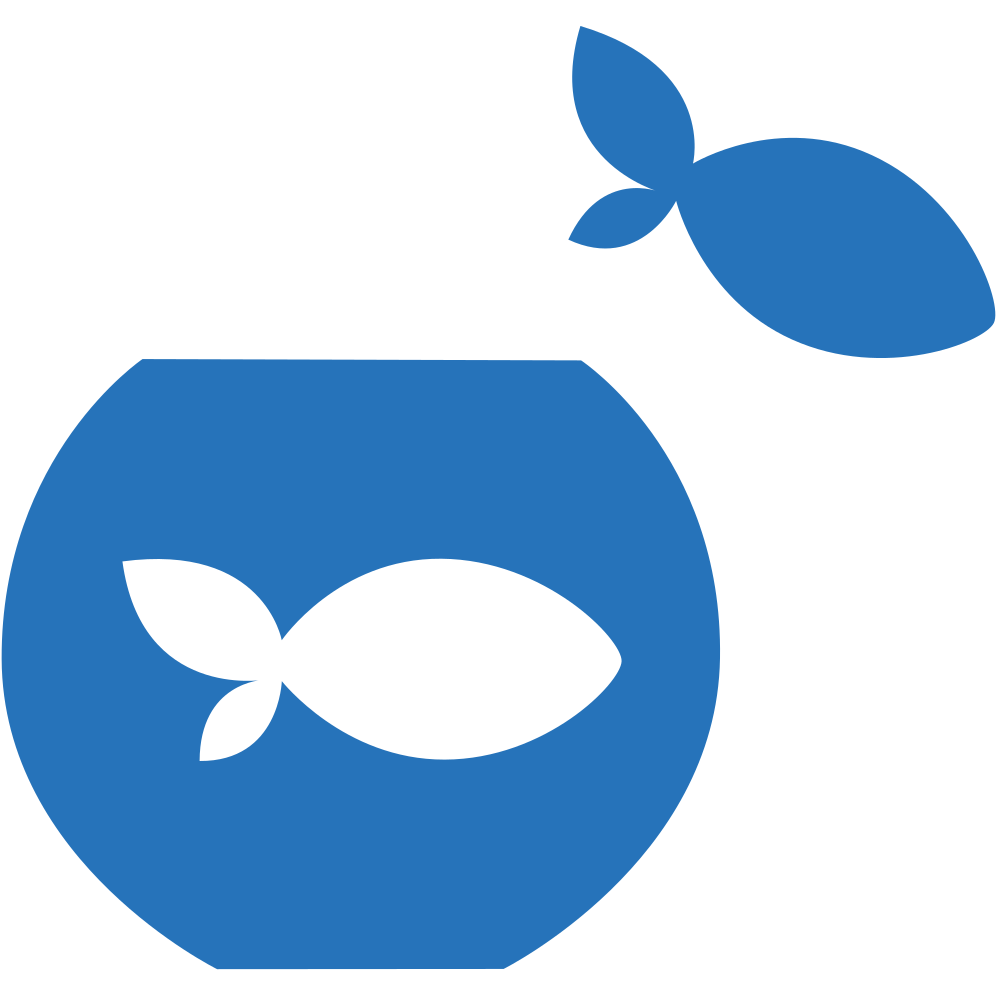
The fish is shown in motion, just after it has left the water. It has not landed. There is no neat arrival on the other side. We chose that unfinished moment because moving abroad is rarely one clean leap from old life to new life.
It starts before departure, with forms, farewells, plans, and doubts. It continues after arrival, in small acts that once happened without thought: registering an address, finding a doctor, understanding a contract, opening a bank account, explaining a qualification, or learning which question to ask first.
The jump carries courage, but it also carries uncertainty. The fish cannot see every condition outside the bowl. People cannot either. A new country is often understood one answer, one person, and one ordinary day at a time.
03
The shape that remains
Inside the blue bowl there is an empty fish-shaped space. Above it, the same fish appears in blue. The two forms belong together. One is the place the fish has left. The other is the fish continuing forward.
That repeated shape is important to us. Moving abroad changes a person, but it does not erase who they were before. Language, humour, memory, habits, work, family, and the meaning of home travel too. Adaptation is not the same as becoming blank. A person can grow into a new place without cutting every thread to the old one.
The empty form is therefore not absence alone. It is a trace. It says that leaving changes the place behind us and leaves a shape in us too. The blue fish says that identity is still alive, still recognisable, and still capable of movement.
04
A world full of questions
Outside the bowl, the world becomes larger and less legible. The difficult part is not only that there are many questions. It is that each question may belong to a different system, and the consequence of a wrong answer can be serious.
International evidence on refugee and migrant health shows how legal status, language, working conditions, housing, and access to services can shape wellbeing together.[1] The strain can also come from separation, uncertainty, discrimination, and the loss of familiar support networks.[2] A housing question can become a legal one. A work question can depend on a visa. A healthcare question may begin with finding someone who speaks the right language.
More search results do not automatically make this easier. Official information may be accurate but hard to apply. Community advice may be generous but specific to one person’s experience. A creator may explain the issue clearly without being qualified to advise on it. Research into cross-border information practices describes how people combine formal and informal sources while judging trust, relevance, and risk.[4]
The real challenge is finding the right kind of help for the question in front of you.
05
What moned can do
This is where the fish meets moned.
moned is being built to help people abroad find human guidance without having to assemble the whole path alone. A person should be able to describe what they need, understand whether the answer belongs to a Professional, a Content Creator, or a Local Guide, and see why that person is relevant before choosing to continue.
Multilingual information platforms already show the value of putting practical, local information into a structure newcomers can use.[3] moned’s role is different and complementary. We want to connect clear information with the person who can explain context, accept responsibility for their scope, or share useful lived experience without pretending those forms of knowledge are the same.
Review, service scope, language, availability, booking, conversation, and follow-up should form one understandable journey. AI may help narrow a search or organise information, but it does not replace accountable human judgement. The goal is not to promise an easy answer to everything. It is to make the next trustworthy answer easier to find.
06
Still in motion
Our fish never reaches a drawn destination. It remains between the known and the possible, carrying its familiar shape into open space.
That is deliberate. moned is not the destination, and no platform gets to define what a good life abroad should look like. The person moving chooses the direction. The people they trust help them understand the terrain. moned can make that meeting clearer, safer, and easier to continue.
The logo is a small picture of a large belief: people should be free to move toward the lives they want without every unfamiliar question becoming a private burden.
The jump belongs to the fish. The next answer should not depend on luck. That is the story of our logo, and the work moned is here to do.
Sources